
 English
 French
 Spanish
 Russian
 Korean
 Japanese
Gardenia Blue Stability: Improving Heat and Light Resistance via Next-Gen Chelation Technology
The "Invisible Killer" of Natural Blue: Why Gardenia Blue Fades
In the food and beverage industry’s pursuit of natural, healthy formulations, Gardenia Blue has gained favor for its pure blue hue. However, a persistent challenge often undermines R&D efforts: color instability. During storage or processing, vibrant blue can unexpectedly darken, turn grayish, or even develop sediment.
The root cause lies in trace metal ions (such as iron, copper, and aluminum) found in water sources, raw materials, or packaging. These ubiquitous ions irreversibly interact with traditional gardenia blue, altering the pigment’s chromophore structure.
This chemical reaction doesn't just cause immediate color inaccuracy—it leads to flocculation and precipitation throughout the shelf life, severely compromising the product's visual quality and consumer experience.
Three Major Commercial Challenges Caused by Color Fading
Innovation Constraints: Many promising concepts, such as mineral-enriched beverages or complex nutritional formulas, are often shelved because developers are forced to switch back to synthetic pigments due to stability issues.
Quality Fluctuations: Minor variations in metal ion content across different raw material batches can cause batch-to-batch inconsistency, significantly increasing quality control (QC) complexity and production waste.
Brand Trust Risks: Color changes and sedimentation in end products directly damage brand reputation, undermining consumer trust in "natural" and "high-quality" label claims.
Green Spring Technology’s Solution: Next-Gen Chelation Technology
Metal ions act as an "invisible killer" of aesthetic value, forming a critical barrier to the large-scale application of natural pigments. Today, Green Spring Technology confronts this challenge head-on.
By implementing our Next-Gen Chelation Technology, we have developed a revolutionary high-stability Gardenia Blue. This technology effectively "locks" the pigment structure, preventing ion interference and ensuring a lasting, vivid blue even in the most demanding formulations.
| See the Stability Test Data |
Technical Breakthrough: The "Dual-Shield" Stability System
To fundamentally solve metal-ion-induced discoloration, Green Spring Technology’s R&D team developed a revolutionary synergistic chelation and targeted encapsulation technology. This is not a simple physical mixture but an intelligent, proactive defense system for Gardenia Blue at the molecular level.
1. Active Capture: Precision Chelation Layer
Through a proprietary process, we integrate a layer of highly selective organic chelating material.
Mechanism: Functions as a "Molecular Magnet," preferentially binding to interfering ions like Fe²⁺/³⁺, Cu²⁺, and Al³⁺.
Result: It neutralizes these ions at the source before they can reach the pigment core, eliminating the chemical triggers for fading and graying.
2. Passive Defense: Dense Physical Micro-barrier
Beyond chelation, we construct a meticulously designed multilayer wall composed of natural polysaccharides and plant proteins.
Mechanism: This dense barrier blocks residual ions and prevents pigment aggregation in complex matrices.
Result: Significantly enhances dispersion stability in protein-rich or high-electrolyte environments while providing exceptional resistance to heat and light.
Performance Validation: 30-Day Accelerated Stability Test
Testing conditions: 40°C in a simulated beverage system containing 2 ppm Fe³⁺ ions.
Test Metrics | Traditional Gardenia Blue (Control) | Green Spring Technology Chelated Encapsulated Gardenia Blue |
Color Difference (ΔE) | > 15 (Visibly darker/grayish) | < 2 (Indistinguishable to the human eye) |
Turbidity (NTU) | Significant increase (Flocculation) | Virtually unchanged (Remains clear) |
Pigment Retention | ≤ 60% | ≥ 98% (Exceptional stability) |
Conclusion: A Strategic Shift in Natural Color Stability
This dual-effect technology of “Active Capture + Passive Defense” marks a new phase in gardenia blue stability management. By transitioning from “Passive Tolerance” to “Active Prevention and Control,” Green Spring Technology provides formulators with an unprecedented stable foundation for product innovation.
Why This Matters for Your Formulation:
Consistent Brand Identity: Ensures your product maintains its authentic, vibrant blue hue across its entire shelf life, even in mineral-rich functional beverages or metal-can packaging.
Unlocking Innovation: Safely develop fortified foods (high calcium/magnesium) and plant-based proteins without the risk of unsightly graying or sedimentation.
Cost-Efficient Stability: High retention rates (≥98%) mean less over-dosing is required, optimizing your Cost-in-Use (CIU) while maintaining a Clean Label profile.
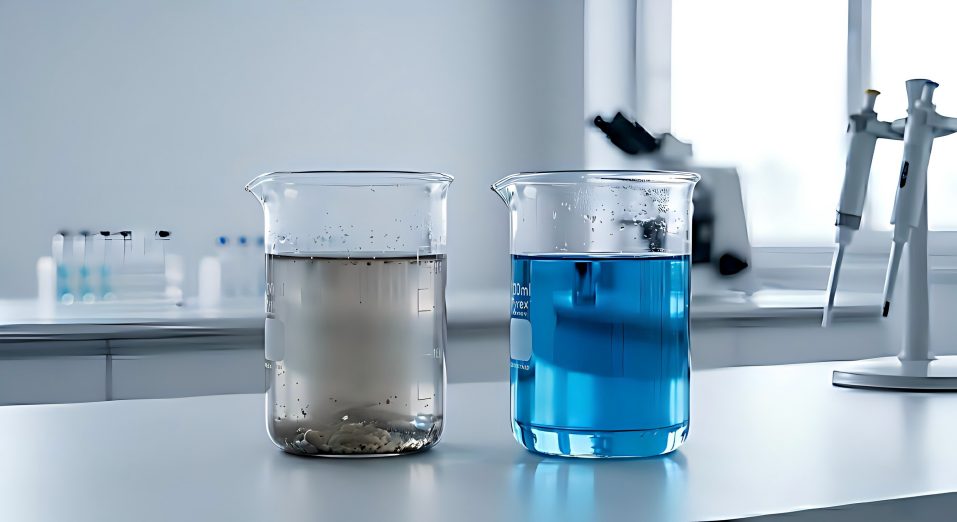
Gardenia Blue stability test comparison: Standard vs Green Spring Chelation Technology
| Get the Technical Data Sheet (TDS) |
How Chelated & Encapsulated Gardenia Blue Redefines Your Product’s Potential
Green Spring Technology’s next-generation chelated encapsulated gardenia blue is more than a technical breakthrough; it is a catalyst for market expansion. By solving the core stability challenges of natural blue, we empower our partners to innovate without compromise.
1. Entering the "Forbidden Zones" of Natural Blue Applications
Traditional gardenia blue was often excluded from high-performance categories. Our dual-shield technology removes these chemical constraints, opening doors to:
Nutritional Fortification: Remains stable in protein drinks and sports recovery beverages, even with high concentrations of calcium, zinc, and iron.
Metal-Packaging Compatibility: Specifically optimized for two-piece cans and foil-based packaging, eliminating the risk of graying caused by metal-ion interaction.
Complex Formulation Systems: Demonstrates exceptional compatibility in health supplements with botanical extracts and fluctuating pH levels, ensuring consistent color brilliance.
2. Enhancing Production Robustness & Reducing Total Cost-in-Use
In large-scale industrial production, stability translates directly into profitability.
Minimal Batch Variation: By neutralizing trace metal interference in raw materials or production water, we ensure precise color matching between every batch.
Higher Yield & Lower Dosage: With a ≥ 98% retention rate, formulators can reduce initial over-dosing, effectively lowering the Cost-in-Use (CIU).
Predictable Shelf Life: Exceptional heat and light resistance extend product shelf life, providing greater flexibility for global logistics and retail operations.
3. Global Compliance: Fortifying Quality and Brand Trust
In a "clean label" era, consistent performance forms the cornerstone of brand reputation. Green Spring Technology provides the regulatory rigorousness your brand requires:
Full Certification Portfolio: Our production system is fully compliant with BRCGS (Grade AA), FSSC 22000, ISO, Halal, and Kosher standards.
Organic Solutions: We offer USDA Organic and EU Organic certified options to support your premium, natural product lines.
Consumer Transparency: Enable your brand to confidently use natural blue pigments while ensuring the product looks as appetizing on the shelf as it did on day one.
Ready to Upgrade Your Natural Blue Formulation?
Don't let stability issues limit your innovation. Contact our technical team today to request a high-stability Gardenia Blue sample or download the full Stability Testing Whitepaper.
| Request a Sample |

Solving Complex Formulation Challenges with Us
At Green Spring Technology, we believe that true innovation isn't just a lab breakthrough—it’s about ensuring your product succeeds on the global shelf. Our next-generation Chelated & Encapsulated Gardenia Blue is designed to be the cornerstone of your brand’s "Clean Label" and "High Stability" promise.
Why Choose Green Spring as Your Natural Color Partner?
Beyond Raw Materials: We don't just supply pigments; we provide comprehensive color solutions. Our R&D team supports you from initial formulation to full-scale production.
Proven Stability for Challenging Matrices: Whether you are dealing with metal ion interference in canned drinks or thermal stress in UHT processing, our technology ensures predictable, vibrant results.
Global Supply Chain Reliability: With decade-long experience, we guarantee consistent quality, rigorous compliance (BRCGS/ISO/Organic), and efficient global logistics.
Ready to Redefine Your Product's Visual Appeal?
Feel free to reach out anytime. We are ready to co-create the next chapter of natural color stability with you.
-
Prev
Highly Stable Curcumin Ingredient Achieves Coloration Across the Entire pH Range
-
Next
Beyond Coloring: Curcumin Redefines the Role of Natural Pigments