

 English
 French
 Spanish
 Russian
 Korean
 Japanese
Quercetin Regulatory Guide: FDA GRAS, EFSA & USP Standards
Quercetin Regulatory Guide: FDA GRAS, EFSA & USP Standards – A Sourcing and Compliance Whitepaper for Global Formulators
In the premium nutraceutical sector, launching a high-efficacy botanical formulation involves navigating complex international regulatory landscapes. Quercetin, a premier polyphenol derived from Sophora japonica, is highly sought after for its proven clinical applications in immune modulation, cellular senolytics, and metabolic health. However, moving a quercetin-based product from R&D to global commercialization requires absolute compliance with distinct regional frameworks.
For Regulatory Affairs Managers, Quality Assurance (QA) Directors, and Procurement Officers, misinterpreting the specific criteria of the United States Food and Drug Administration (FDA), the European Food Safety Authority (EFSA), or United States Pharmacopeia (USP) specifications can lead to costly customs detentions, product recalls, or brand-damaging market rejections.
At Green Spring Technology, with 25+ years of continuous phytogenic extraction expertise and robust independent quality management, we prioritize international regulatory harmonization. This compliance guide breaks down the essential legal baselines required to successfully launch premium quercetin products across global target markets.
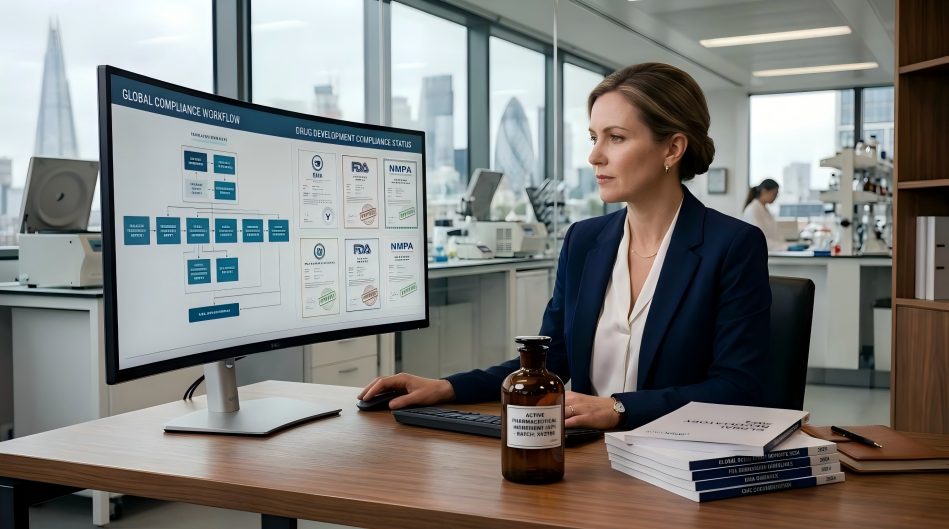
United States Market: Navigating FDA Compliance and GRAS Status
In the United States, commercial ingredients must be legally qualified before entering the consumer pipeline, typically as a Dietary Supplement under DSHEA (Dietary Supplement Health and Education Act) or as a conventional food ingredient through a GRAS (Generally Recognized as Safe) determination.
Dietary Supplement Qualification
If utilized as a dietary supplement, manufacturers must ensure their source material complies with Section 413(a)(2) of the FD&C Act. Quercetin derived from traditional botanical extraction processes with a historical presence in the US market prior to October 15, 1994, is generally categorized as an Old Dietary Ingredient (ODI). However, for advanced engineered grades—such as ultra-pure anhydrous or microencapsulated systems—reputable suppliers must demonstrate that the molecular composition remains identical to compendial specifications to avoid triggering an NDI (New Dietary Ingredient) notification requirement.
Conventional Food Integration (GRAS)
For brands integrating quercetin into functional foods, energy bars, or ready-to-drink (RTD) beverages, achieving GRAS status is mandatory. A valid GRAS determination requires consensus among scientific experts that the substance is safe under the intended conditions of use.
Daily Exposure Thresholds: Typical consensus evaluations for high-purity Sophora japonica quercetin cap general food addition at 100 mg to 200 mg per serving, not exceeding an estimated daily intake (EDI) of 500 mg per day.
Intended Uses: Commonly approved categories include meal replacement bars, functional sports drinks, and medical foods targeted toward specific inflammatory and metabolic protocols.
Reuest FDA/GRAS Compliance Data
European Union Market: Navigating EFSA and Novel Food Status
The European Union maintains some of the world's strictest regulatory boundaries for botanical concentrates, governed directly by the EU General Food Law (Regulation EC No 178/2002) and the Novel Food Regulation (EU) 2015/2283.
The Novel Food Boundary
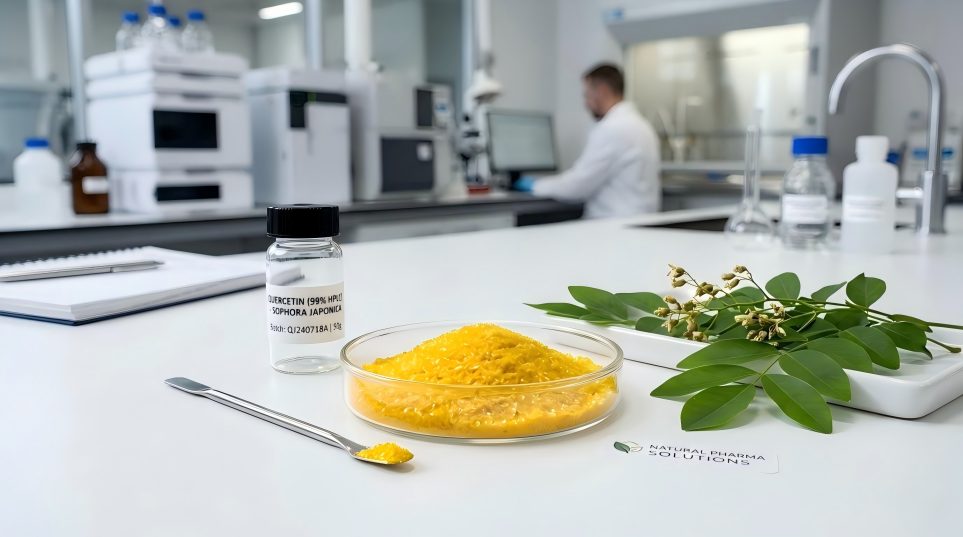
Any food or ingredient that was not consumed to a significant degree within the EU before May 15, 1997, falls under the Novel Food category. High-purity quercetin extracted from Sophora japonica leaves or flower buds must be rigorously verified against Authorized Novel Food listings.
EFSA Specifications for Premium Extracts
When sourcing an authorized Novel Food grade of quercetin for European markets, the ingredient profile must match the strict scientific opinions handed down by EFSA.
Maximum Recommended Dosage: EFSA safety assessments generally restrict the maximum intake to 860 mg of pure quercetin per day for adult populations, excluding pregnant and lactating women.
Target Group Restrictions: Product labels within the EU must explicitly state that the supplement should not be consumed by children or adolescents under 18 years of age.
Identity Profiles: EFSA mandates that the source material must be a highly purified crystalline concentrate, ensuring that residual companion flavonoids from the plant source (such as rutin or isoquercitrin) are strictly accounted for and standardized.
Download EU Compliance & TDS Packages
Global Quality Audit Benchmarks: Meeting and Exceeding USP Standards
Beyond regional health authority approvals, the universal standard for chemical and physical identity verification remains the United States Pharmacopeia (USP). A valid QA procurement audit demands that every incoming batch of quercetin meets or exceeds current USP compendial monographs.
Identity and Assay Specifications
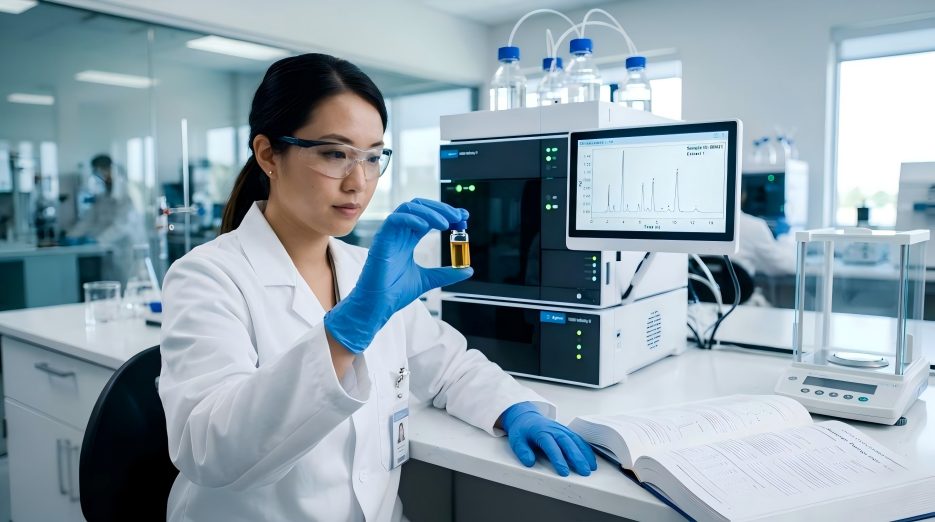
USP standards dictate that commercial Quercetin raw material must possess an assay threshold of 95.0% to 103.0% on an anhydrous basis, quantified strictly via High-Performance Liquid Chromatography (HPLC).
Contaminant Thresholds (The Safety Baseline)
Green Spring Technology subjects all production lots to validated in-house testing alongside independent third-party ISO/IEC 17025 accredited laboratory cross-validations to guarantee full compliance with global safety thresholds:
Heavy Metals (USP <2232>): Lead (≤0.5 ppm), Arsenic (≤1.0ppm), Cadmium (≤0.5ppm), Mercury (≤0.1ppm).
Residual Solvents (USP <467>): Class 2 and Class 3 processing solvents (such as ethanol or methanol) must fall significantly below international ICH limits, ensuring complete safety from industrial chemical carryover.
Polycyclic Aromatic Hydrocarbons (PAHs): Total PAHs are monitored strictly to meet EU standards (≤50ppb total, and Benzo(a)pyrene ≤10 ppb) to mitigate the environmental contamination often found in lower-grade botanical sourcing.
Download Full USP Compliance & CoA Package
Technical Harmonization Matrix for Global Procurement Audits
To streamline your vendor qualification process, the table below aligns Green Spring’s commercial portfolios with international compendial standards:
Regulatory Parameter | USP Compendial Monograph | Green Spring Premium Specifications | Strategic Formulation Advantage |
Assay (HPLC, Dry Basis) | 95.0% - 103.0% | ≥98.0% Pure Active | Guarantees lower excipient volume requirements in multi-ingredient blends. |
Heavy Metals (Total) | ≤10.0 ppm | ≤3.0 ppm Max | Eliminates risk of accumulation in premium multi-vitamin lines. |
Residual Ethanol | ≤5,000ppm (Class 3) | ≤1,000 ppm | Ideal for strict clean-label designations and sensitive liquid matrices. |
Pesticide Residues | Compliant with USP <561> | Zero Detectable Residues | Facilitates frictionless customs clearance across EU and North American borders. |
Secure a Frictionless Supply Chain with Green Spring Technology
In an environment of intensifying regulatory scrutiny, sourcing your active ingredients from an unverified supply chain introduces severe operational risk. Partnering with Green Spring Technology means securing a transparent, 25-year-validated pipeline supported by complete documentation packages, including Allergen Statements, TSE/BSE-Free Certificates, Kosher/Halal compliance, and Non-GMO Project declarations.
Optimize your next product rollout and eliminate compliance bottlenecks today.
-
Prev
The Ultimate B2B Quercetin Sourcing Guide: Purity, Particle Size, and Compliance for Global Brands
-
Next
Anhydrous Quercetin Powder for Moisture-Sensitive Formulations